1 November 2026 · Rent evidence
The 13% haircut I had wrong
Let-agreed rents across twelve North East towns, and why one blanket discount cost me a fortnight of deals.
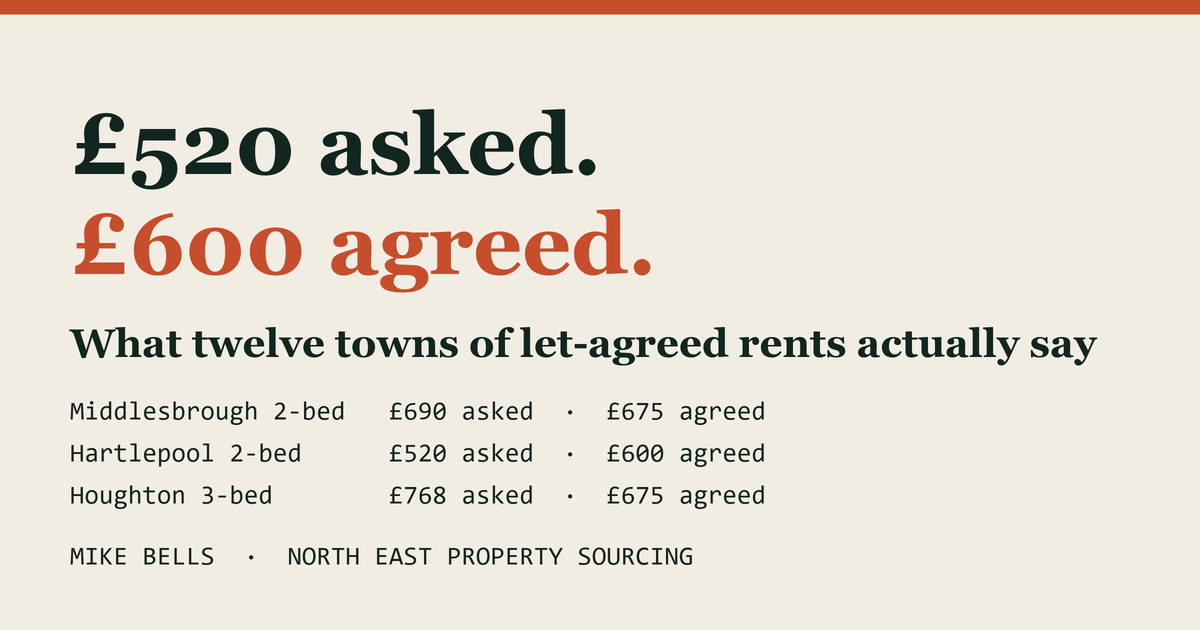
For two weeks I applied a rule to every rent in the North East: knock 13% off the asking rent, because asking rents are optimistic. It is a sensible-sounding rule. Agents advertise high, tenants negotiate, and the figure that matters is what was actually agreed.
Then I went and found the let-agreed data, and the rule turned out to be wrong in most of the towns I buy in.
What let-agreed actually shows
Rightmove lets you see the rentals that have been marked let agreed. Compare those against the ones still asking, in the same town and the same bedroom count, and you get the real gap between what is asked and what is agreed.
In Middlesbrough, two-bedroom asking rents run at about £690 a month and the let-agreed median is £675. That is a 2% gap, not 13%.
In Middlesbrough, three-beds: £750 asked, £750 agreed. No gap at all.
In Hartlepool, two-beds average £520 asking, and the let-agreed median is £600. The agreed rent is 15% higher than the asking rent, which sounds impossible until you look at what is being advertised: a lot of cheap Hartlepool stock is advertised low because it is in poor order, and the houses that let are the better ones.
In Darlington, three-beds: £775 asking, £788 agreed. In Ferryhill: £575 asking, £598 agreed. In Seaham: £732 asking, £780 agreed.
And then Houghton-le-Spring, where three-beds ask £768 and agree at £675. That is a 12% gap, and it is the one place where my haircut was about right.
Why the rule mattered
I had been using 13% as a blanket assumption, and it was killing deals. A two-bedroom in Hartlepool at £600 a month became £522 in my spreadsheet. On a £60,000 purchase that was the difference between a deal that just about works and one I rejected.
The mistake was not the direction of the haircut. It was applying one number to twelve towns. The gap between asking and agreed is a local fact, not a national rule, and it moves with the quality of the stock in each town.
What I do now
I take the let-agreed median for the town and bedroom count, and I say how many lets it is based on. If the sample is thin, I say that too and treat the figure as a hint rather than evidence. Where an agent tells me what a specific house will let for in writing, that beats both.
The best evidence, in order: an agent's written figure for that house, then let-agreed listings in that town, then asking rents with a haircut, and last of all a guess. I spent two weeks on the last one.
The number that still decides it
None of this changes the arithmetic that matters. At six per cent interest, a loan against 75% of the finished value costs £375 a month for every £100,000. A house has to let for roughly 1.1% of its finished value each month to return twenty per cent, and most of the North East sits nearer 0.7%.
Getting the rent right does not make a bad deal good. It stops you rejecting a good one for the wrong reason, which is what I did for a fortnight.
If you want the let-agreed figures for your own town, they are in the rent map on this site, and I update them as the data comes in.
Two houses, worked through
Both of these are real shapes from the Hartlepool and Teesside market, with the numbers rounded and the addresses left out. One works and one does not, and the difference is not the discount.
Property A. Purchase £40,000, works £8,000, finished value £48,000, rent £750 a month.
- Cash needed: £56,000 (purchase, 5% stamp duty, £1,500 legal, £1,000 survey, £3,500 sourcing fee, £8,000 of works)
- Refinance at 75% of £48,000: £36,000
- Money left in: £20,000
- Interest at 6%: £180 a month. Management at 12%, insurance and running costs: £323
- Net: £247 a month, which is a 14.8% return on the £20,000 left in
Property B. Purchase £60,000, works £18,000, finished value £75,000, rent £522 a month.
- Cash needed: £87,000
- Refinance at 75% of £75,000: £56,250
- Money left in: £30,750
- Interest at 6%: £281 a month
- Net: minus £55 a month
The difference is the rent against the finished value. Property A lets for 1.6% of its end value each month. Property B lets for 0.7%. Six per cent interest does the rest.
The test I use now, before anything else: rent divided by finished value. Below 0.7% a month it cannot work at today's rates, whatever the discount. Above 1.1% it can. Everything in between is a negotiation, and most of the North East sits in between.
---
Numbers like these go out every Thursday. Two or three a week, each checked against what the street actually sold for and what the house actually lets for. If you want them as they happen, put your email in at mikebells.co.uk/contact and say "the Thursday list". If it is not useful, say so and that is the end of it.
---
Three things you can do with this
Know someone buying or selling in the North East? Introduce us. If a purchase or sale completes from that introduction, £500 comes off the fee — for them, or for you.
Want the full rent table? Every town we track, let-agreed rents, updated weekly. Reply with "numbers" and I'll send it.
Or just tell me your town and I'll send you what two and three-bed houses actually let for there, not what they are advertised at.
Tell us what you are looking for
Sent straight to me, not to a list
If you are looking for something specific in the North East — a street, a yield, a budget — describe it here. I reply to everything within one working day, and there is no charge for asking.
If you want the weekly version — what I screened, what the numbers said, and what I got wrong — it is free here.